


What Is an Industrial Steam Turbine? A Complete Breakdown of Core Principles and Basic Applications
2026-07-22 00:00In the field of industrial energy and power, steam turbines are indispensable core equipment, widely supporting the stable operation of major industries such as electric power generation, chemical processing, metallurgical manufacturing, and marine propulsion. Many people have a vague understanding of steam turbines. In fact, steam turbines, also known as steam turbine engines, are mature and efficient rotary steam power devices. With their stable energy conversion capability, they have become key equipment for thermal energy utilization and power output in modern industrial systems.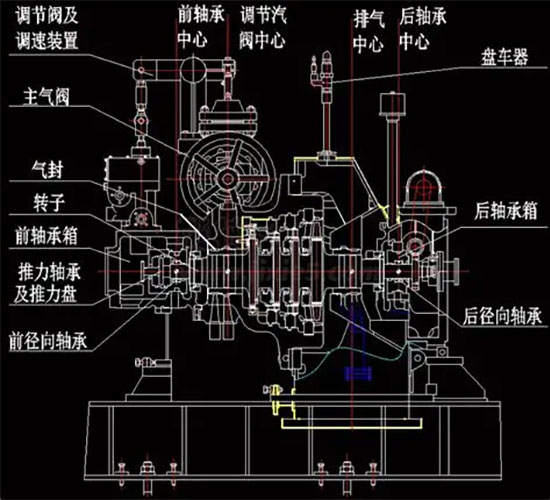 From the perspective of core definition and working principle, the primary function of a steam turbine is to efficiently convert thermal energy into mechanical energy. Its operating logic is straightforward: high-temperature, high-pressure steam is generated by a boiler or other steam generator. When the high-speed steam passes through fixed nozzles, it forms a rapidly accelerating airflow that is precisely directed onto the rotor blades. The high-speed airflow continuously impacts the blades, causing the bladed rotor to rotate at high speed, thereby converting the thermal and kinetic energy of the steam into rotational mechanical energy of the rotor. This mechanical energy is then used to drive generators, fans, pumps, and other equipment. Compared with traditional power equipment, steam turbines rely on a continuous and stable steam flow to perform work, offering smooth operation and uniform power output, making them one of the most reliable mainstream machines in industrial power equipment.
Compared with traditional reciprocating steam engines and other power equipment, industrial steam turbines possess many core advantages, which are also the key reasons for their widespread adoption across various industries. First, they offer high power output: steam flows continuously at high speed, achieving high work efficiency per unit flow, capable of meeting the power demands of large industrial units. Second, they have high operating efficiency: they can match high-parameter steam conditions and make full use of steam thermal energy through multi-stage expansion, significantly reducing energy losses. At the same time, steam turbines feature robust construction, low operating noise, and long service life. They can operate continuously and stably over long periods, perfectly adapting to the round-the-clock, uninterrupted production modes of industrial enterprises, effectively reducing equipment maintenance costs and downtime losses.
Relying on outstanding performance advantages, industrial steam turbines cover multiple core areas of the national economy with strong adaptability. In the electric power industry, steam turbines are the core main equipment of thermal power plants, serving as the primary power source for thermal power generation and combined heat and power (CHP), supporting basic social electricity supply and district heating. In the chemical and petroleum industries, steam turbines are often used as drive equipment to power compressors, pumps, fans, and other auxiliary machinery, while also being suitable for industrial waste heat recovery, helping enterprises save energy and reduce costs. In the metallurgical industry, they can match industrial production conditions and provide stable power support for smelting production lines. In addition, steam turbines are an important component of ship propulsion systems, ensuring stable power supply for vessel navigation thanks to their steady power output characteristics.
As precision heavy-duty equipment operating in an integrated system, a steam turbine cannot work alone; it requires a complete set of supporting systems to operate collaboratively, forming an integrated power system. The entire equipment set mainly includes a steam generation system, a power conversion system, a circulating cooling system, and an auxiliary control system. Core supporting equipment includes boilers, generators, condensers, heaters, and various feed pumps. Each piece of equipment has a clear division of labor and works in coordination to complete the entire process of steam generation, energy conversion, condensation circulation, and heat recovery, ensuring long-term stable, efficient, and energy-saving operation of the steam turbine. This well-established supporting system also allows steam turbines to adapt to different working conditions and industrial production scales of varying sizes.
Looking back at the development history of industrial power equipment, steam turbines have consistently occupied a central position in the industrial power field due to their mature structure, excellent energy efficiency, and wide applicability. Whether in traditional thermal power generation, industrial waste heat utilization, or power driving of large equipment, industrial steam turbines play an irreplaceable role. For industrial enterprises, gaining an in-depth understanding of the working principle and application characteristics of steam turbines can better facilitate equipment selection, working condition adaptation, and energy-saving retrofitting, maximizing the operational value of the equipment.
In the future, as the concepts of industrial energy conservation, carbon reduction, and green production continue to deepen, industrial steam turbines will keep upgrading toward higher efficiency, greater precision, and better energy savings. They will continuously optimize energy conversion efficiency, adapt to more new industrial working conditions, and steadily provide reliable power support for the high-quality development of various industries.