


Interpretation of Industrial Steam Turbine Classification and Application Scenarios: Empowering Selection of Industrial Energy-Saving Equipment
2026-07-14 00:00In modern industrial energy systems, industrial steam turbines play a core role in heat-to-power conversion, mechanical drive, and waste heat recovery. They are indispensable main equipment in industries such as thermal power generation, petrochemicals, and metallurgical manufacturing. In recent years, domestic industrial energy-saving retrofitting, comprehensive waste heat utilization, and integrated park-level energy construction have accelerated. Different production scenarios impose increasingly specific requirements on turbine parameters, structures, and operating modes. Based on thermodynamic operating characteristics, work principles, structural forms, steam pressure levels, steam flow paths, and actual application scenarios, the industry has established a complete and mature classification standard for steam turbines. This enables precise matching of machine types to different working conditions, providing a solid technical foundation for equipment selection, scheme design, and energy-saving retrofitting in industrial projects.
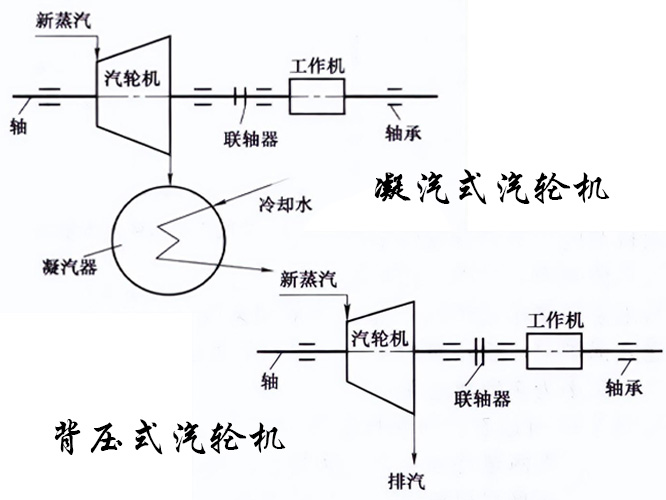
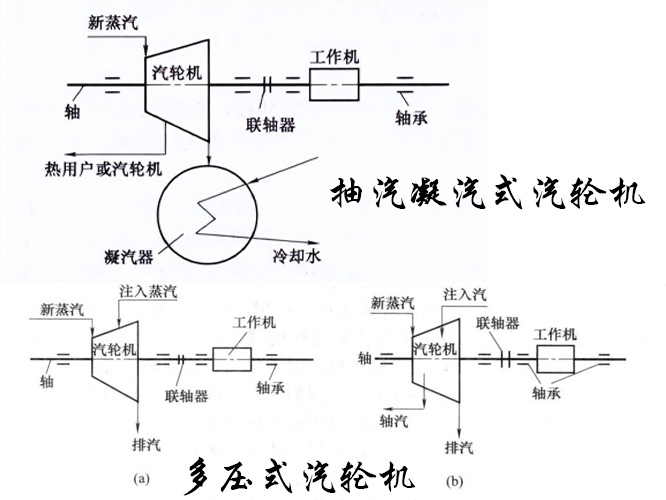
Classified by thermodynamic operating mode, industrial steam turbines mainly fall into five common types, covering most industrial heating, power generation, and mechanical drive applications. Condensing steam turbines are widely used in power plants and large chemical facilities. After doing work, the steam enters a condenser under negative pressure for condensation. Combined with regenerative water extraction, this effectively improves overall cycle efficiency and is currently the most widely applied basic type. Extraction condensing steam turbines are multi-functional: during operation, part of the steam at a certain pressure can be extracted for production lines or heating networks, while the remaining steam continues to expand and condense. This type is ideal for combined heat and power (CHP) projects in chemical parks. Back-pressure steam turbines have exhaust steam pressure higher than atmospheric pressure, and the discharged steam can be directly supplied to downstream processes or low-pressure units for secondary use. They are commonly used for industrial cascade energy utilization and waste heat recovery. In addition, exhaust steam turbines, which operate on waste steam from other devices or process by-product steam, and multi-pressure steam turbines, which can accept multiple streams of process steam at different pressures, address unconventional energy utilization challenges and meet customized production needs.
From the perspective of work principles, steam turbines on the market are mainly classified into impulse type, reaction type, and combined impulse-reaction type. In impulse turbines, steam expansion occurs primarily in the nozzle blades, and the moving blades receive the kinetic energy of the steam jet to do work. This type features simple structure, stable operation, and easy maintenance, making it suitable for most conventional conditions. In reaction turbines, steam expands progressively in both stationary and moving blades, achieving higher thermal energy conversion efficiency and superior energy savings. The combined impulse-reaction turbine integrates the technical characteristics of both types, balancing stability and efficiency, and is capable of handling high-load, continuous, and complex industrial operations. It is also the mainstream choice for advanced industrial projects today.
Structural configuration and steam pressure parameters are important references for industry selection. According to structural hierarchy, turbines can be divided into single-stage and multi-stage types. Single-stage units have a compact structure, small size, and relatively low power output. They are often used to drive fans, pumps, and small auxiliary equipment, and are common in chemical supporting applications. Multi-stage turbines have more stages, higher precision, greater power output, and stronger operational stability. They can be adapted to various configurations including condensing, back-pressure, extraction, and multi-pressure types, and are widely used in large and medium-sized industrial projects. Based on the pressure level of the incoming live steam, the industry classifies equipment into six grades: low pressure, medium pressure, high pressure, ultra-high pressure, subcritical, and supercritical. These correspond respectively to light industrial supporting, general chemical, heavy industrial energy, and large-scale power station applications, enabling precise matching of working conditions and parameters.
According to steam flow path, turbines are categorized into axial flow, radial flow, and tangential flow types, allowing flexible selection based on installation space and piping layout. From the perspective of practical application fields, turbines are mainly divided into three categories: power station turbines, marine turbines, and industrial turbines. Among these, industrial turbines have the richest variety of application scenarios, meeting diverse needs such as captive power plant generation, production heating, mechanical drive, and combined heating-and-drive solutions. They are fully applicable to chemical, oil refining, metallurgy, and other manufacturing industries. Additionally, the industry can further classify turbines based on the number of shafts and cylinders, forming a comprehensive, multi-dimensional classification system covering all kinds of specialized working conditions.
Nowadays, industrial energy conservation, carbon reduction, and waste heat resource utilization have become core directions for manufacturing upgrading. Customers' equipment selection is no longer limited to general-purpose models; they place greater emphasis on condition adaptability and operational energy efficiency. A well-established steam turbine classification system provides clear standards for project scheme design, equipment selection, and customized retrofitting, driving the industry from generalized equipment supply toward refined, scenario-specific, and high-efficiency customized services. For equipment manufacturers, thoroughly understanding the structural characteristics, work principles, and applicable scenarios of various steam turbine types is essential to accurately match customers' production conditions and deliver high-compatibility, high-stability, and high-utilization integrated power solutions.
Looking ahead, against the backdrop of future industrial energy upgrades and overseas infrastructure expansion, different types and parameters of industrial steam turbines will continue to play key roles in their respective niches. Industry development will keep iterating around improving energy efficiency, optimizing structure, and enabling intelligent operation, leveraging mature classification systems to deepen market penetration. Manufacturing enterprises will take precision selection, high-quality manufacturing, and stable supporting services as their core advantages, helping industries complete energy-saving retrofits and green upgrades, and steadily promoting the high-quality and sustainable development of the industrial power equipment sector.