


Facing the Era of Small Modular Reactors, Steam Turbines Embark on a New Design Route
2026-10-22 00:00As a core direction for the development of low-carbon electricity, Small Modular Reactors (SMRs) are widely recognized. While reactor core technology continues to advance, the steam turbine island—serving as the heart of energy conversion—is undergoing a quiet yet profoundly significant technological evolution. Unlike conventional thermal power and large-scale nuclear steam turbines, steam turbines adapted for SMR units must directly confront a series of technical challenges posed by high-moisture steam, ensuring long-term safe and stable operation through entirely new design solutions.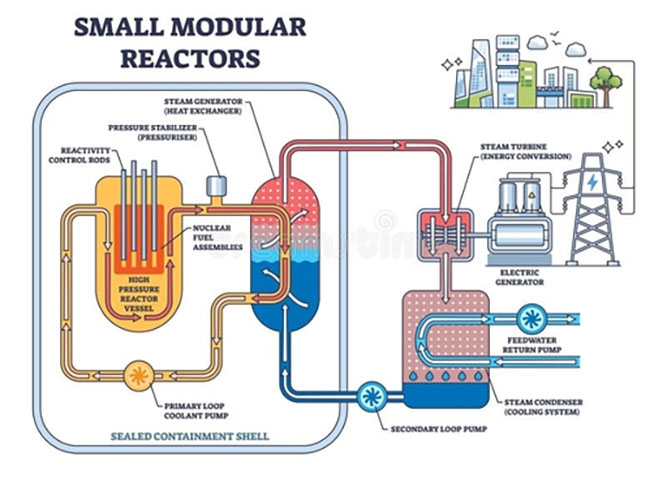
The design of SMR steam turbines requires integrating the mature experience of two major engineering systems: fossil fuel power plants and large-scale nuclear power plants. In terms of power rating, steam turbines for most SMRs have output levels comparable to those of coal-fired power plants and industrial steam turbine units. However, their steam conditions closely resemble those of large-scale nuclear power plants—especially for models paired with pressurized water reactors (PWRs) and boiling water reactors (BWRs), where the turbine inlet steam is near-saturated. This gives rise to the prominent "wet steam" challenge.
For SMRs built on the traditional Gen-III+ technical route, the exhaust steam moisture of both the high-pressure (HP) and low-pressure (LP) turbine modules can exceed 15%. In contrast with fossil fuel units of similar scale, thermal power turbines have essentially zero moisture in the HP section, and their LP exhaust moisture is only about 10%. Under high-moisture conditions, fine water droplets in the steam continually coalesce and grow, persistently impacting the blades. This causes blade erosion and can also induce stress corrosion cracking of the metal, severely shortening blade service life and posing the risk of unplanned shutdowns.
In response to high-moisture steam conditions, the industry has developed a combined set of solutions. In large-scale nuclear power projects, moisture separator reheaters (MSRs) are commonly deployed to remove liquid water from HP exhaust steam and reheat it, thereby protecting LP flow path components. In addition, material and surface strengthening processes have become the core means of blade protection. Through optimized material selection, heat treatment processes, and composition control for rotors and blades, the risk of stress corrosion cracking is reduced at the source. LP rear-stage blades widely adopt shot peening and strain hardening processes, introducing residual compressive stress into the surface layer to enhance resistance to fatigue, corrosion, and water droplet erosion.
At the flow path structural level, the design uses centrifugal force to separate and extract moisture from the steam flow passage. Meanwhile, slotted guide vanes are adopted upstream of the last-stage blades to directly strip water films from blade surfaces, reducing the formation of large droplets and mitigating impact damage to the final-stage blades. The last-stage blades represent the area most severely affected by wet steam erosion. Effective moisture removal and protection can reduce the frequency of spare part replacement and lower the full-lifecycle operation and maintenance costs of the power plant.
Beyond wet steam protection, SMR steam turbines must also accommodate an ultra-long design life of 80 years—twice the service life of conventional fossil fuel power plant units. Long-term service demands targeted optimization of blades, rotors, and shafting structures. Lightweight blade profiles and improved blade root designs reduce the stress corrosion risk caused by the enormous centrifugal tensile forces of long blades. At the same time, nuclear safety requirements must be taken into account. Although the turbine island is physically isolated from the nuclear island, under compact site conditions, equipment design must satisfy rigorous probabilistic safety assessments, relying on redundant protection and control systems to guard against extreme conditions such as overspeed and component failure. Some boiling water reactor-type SMR designs also require consideration of radiation protection from radioactive steam, optimizing equipment layout to reduce radiation exposure risk for operation and maintenance personnel.
The ultimate goal of all optimizations in SMR steam turbines is to reduce the levelized cost of electricity (LCOE). High-efficiency controlled vortex blades, optimized last-stage blades, and improved steam inlet structures enhance the thermal efficiency of the unit and modestly increase power output. Simplified shafting and a reduced number of bearings minimize mechanical losses while enabling a compact modular structure with factory pre-assembly.
As the core equipment of the SMR power generation system, the steam turbine island is a critical link in the commercial deployment of SMRs. By integrating the full-speed shafting design experience of thermal power plants with the wet steam operation expertise of nuclear power plants, the new generation of modular steam turbines will support the steady global promotion of small modular reactors in the low-carbon electricity market.