


Refined Selection Guide | Complete Classification System and Applicable Working Conditions of Industrial Steam Turbines
2026-08-05 00:00In industrial waste heat power generation, combined heat and power (CHP), and equipment-driven power projects, the selection of a steam turbine directly determines the operating efficiency, energy consumption level, and adaptability stability of the entire system. During the equipment procurement phase, many enterprises are prone to issues such as energy efficiency waste, installation mismatches, and working condition incompatibility due to improper machine type selection. Industrial steam turbines have a multi-dimensional, standardized classification system, with different categories corresponding to specific production conditions, steam parameters, and usage scenarios. From an engineering practice perspective, clarifying the differentiated advantages and applicable scopes of various machine types is the core key to precise project selection, quality improvement, and cost reduction.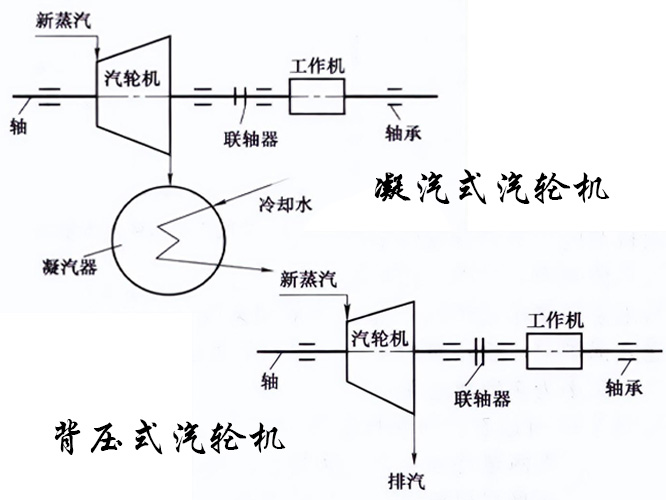
Divided by core working principle, industrial steam turbines are mainly classified into two mainstream types: impulse turbines and reaction turbines. Their energy conversion logic and applicable scenarios differ significantly, making them a core reference for selection. In an impulse turbine, the steam expansion process is concentrated in the stationary nozzle blades, while the moving blades only receive the kinetic energy of the airflow to perform work. This type features a simple structure, strong resistance to load fluctuations, and convenient maintenance. It is more suitable for small and medium-sized units and variable operating condition scenarios, and is often used in industrial auxiliary equipment drives and small-scale waste heat utilization projects. In a reaction turbine, steam expands and performs work step by step in both stationary and moving blades, resulting in higher thermal energy utilization, smoother operation, and outstanding overall energy-saving advantages. It is widely applied in large power stations, large-scale CHP projects, and other long-term full-load operating projects. Currently, most large industrial units adopt an impulse-reaction combined structure, integrating the advantages of both types to adapt to complex and changing industrial production conditions.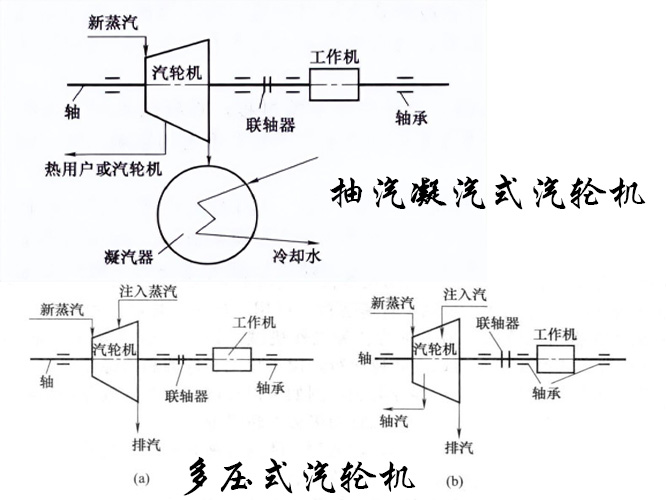
Classification based on thermal characteristics is the most commonly used and most production-demand-oriented standard for industrial project selection, precisely matching the different needs of enterprises for heating, power generation, and waste heat recovery. Condensing steam turbines focus on pure power generation. After performing work, the steam is condensed under negative pressure, making full use of thermal energy. They are suitable for captive power plant projects that have no heating demand and focus mainly on power output. Extraction condensing steam turbines are multi-functional. During operation, they can precisely extract steam at different pressures to supply industrial production or municipal heating, while the remaining steam continues to expand and generate electricity. They are perfectly suited for industrial park CHP projects and multi-process energy scenarios in chemical plants. Back-pressure steam turbines have exhaust steam pressure higher than atmospheric pressure, allowing the residual steam after work to be directly supplied to downstream equipment for secondary use. They are the preferred choice for industrial cascade waste heat utilization and energy-saving retrofitting in high-energy-consumption enterprises. In addition, exhaust steam turbines, which utilize industrial by-product waste steam, and multi-pressure steam turbines, which can accept multiple streams of steam at different pressures, can specifically solve energy utilization problems under special conditions, adapting to niche and customized industrial production scenarios.
Steam pressure parameters are hard technical indicators for steam turbine selection, directly corresponding to the project's energy consumption level and equipment configuration standards. The industry divides steam parameters into seven levels based on live steam pressure, precisely covering the working conditions of all industries. Low-pressure and medium-pressure models are suitable for light industry, small-scale chemical plants, and conventional industrial waste heat projects, offering stable parameters and high cost-effectiveness. High-pressure and ultra-high-pressure models are mostly used in CHP projects in medium-sized petrochemical and metallurgical enterprises. Subcritical, supercritical, and ultra-supercritical models rely on advanced materials and precision manufacturing processes, adapting to large-scale thermal power plants, large-scale energy bases, and other high-power, high-efficiency core projects. They can significantly reduce energy consumption per unit of power and improve the overall economic benefits of the project. Enterprises can precisely match the corresponding pressure grade unit based on their own boiler steam parameters and production load, avoiding energy losses caused by parameter mismatch.
From the perspective of equipment structural form, the differentiated designs of single-stage vs. multi-stage, single-cylinder vs. multi-cylinder, and single-shaft vs. dual-shaft determine the power level and operating scenario of the unit. Single-stage steam turbines feature a compact structure, small size, and low cost. They are mostly used to drive small auxiliary equipment such as pumps and fans, adapting to low-power, intermittent operation scenarios. Multi-stage steam turbines, through multi-stage staged work, offer greater power, higher energy efficiency, and more stable operation, making them the mainstream choice for industrial main units. Single-cylinder units have a simple structure and convenient maintenance, suitable for small and medium-sized projects. Multi-cylinder units have strong power capacity and wide working condition adaptability, mostly used in large-scale industrial projects. Single-shaft units offer stable transmission and compact structure, adapting to most conventional conditions. Dual-shaft and multi-shaft units are designed for ultra-high power and high-load operation scenarios, meeting the production needs of high-end large-scale energy projects.
Divided by actual purpose, industrial steam turbines can be clearly classified into three categories: power station turbines, industrial turbines, and marine turbines. The scenario boundaries are clear and functional positioning is definite. Power station turbines focus on power generation and CHP, adapting to fixed, large-scale power generation projects. Marine turbines emphasize miniaturization and high stability, adapting to ship propulsion scenarios. Industrial turbines have the widest range of applications, capable of simultaneously meeting multiple needs such as captive power plant generation, production line heating, and mechanical equipment driving, flexibly adapting to various manufacturing industries such as chemicals, oil refining, and metallurgy.
In summary, the multi-dimensional classification system of industrial steam turbines essentially provides standardized and precise selection criteria for different industrial working conditions. Accurately distinguishing the principles, thermal characteristics, parameter levels, and structural differences of various machine types can avoid selection errors at the source, maximize the energy-saving advantages of the equipment, and ensure the long-term efficient and stable operation of the unit. For industrial enterprises, relying on a well-established machine type classification logic to customize suitable equipment is an important way to achieve energy conservation, carbon reduction, quality improvement, and efficiency enhancement. It is also the core trend in the refined application of industrial power equipment.