


Dissecting the Core Structure | Detailed Explanation of Key Component Structures and Functions of Steam Turbines
2026-08-13 00:00Industrial steam turbines are high-precision heavy-duty power equipment that operates continuously under high temperature, high pressure, and high-speed rotating conditions. The equipment has a complex structure and extremely high requirements for component fitting accuracy. Many equipment failures, energy efficiency losses, and unstable operation issues originate from the structural matching, assembly precision, and working condition adaptation of core components. An in-depth understanding of the internal structure of steam turbines, the functional characteristics of each component, and structural differences is the foundation for stable equipment operation, precise maintenance, and customized supporting services. It is also a core reflection of the technical strength of power equipment manufacturing enterprises.
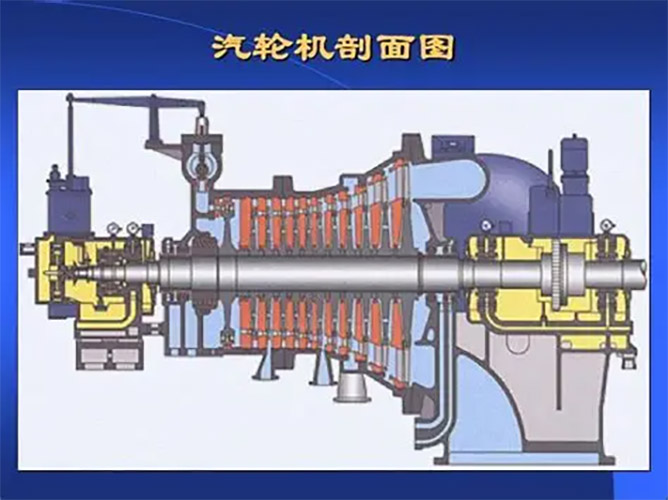
Overall, the steam turbine structure is mainly divided into two core systems: the rotor system composed of rotating parts and the stator system composed of stationary parts. All functions of operation, work output, energy conversion, sealing, and support are accomplished by the coordinated action of these two systems, neither of which is dispensable.
The rotor is the core moving part of the steam turbine and the main carrier of power output. It is integrally forged from high-strength alloy steel and bears all centrifugal forces and torque loads during operation. According to different structural processes, the industry classifies rotors into four types: shrunk-on rotors, integral forged rotors, welded rotors, and combined rotors, each suitable for different pressure level working conditions. Shrunk-on rotors are convenient to process and cost-controllable, mostly used in medium and low-pressure units. Integral forged rotors are formed as a single forging piece, completely avoiding the problem of component loosening under high-temperature conditions, and are widely used in high-pressure and medium-pressure large units. Welded rotors are formed by segmental forging and welding, featuring light weight and high structural strength, suitable for large low-pressure units. Combined rotors integrate the advantages of multiple structures, adapting to complex variable-condition operation scenarios while balancing stability and economy. The overall precision and dynamic balance level of the rotor directly determine the vibration value and service life of the unit.
The stator system, with the cylinder, diaphragms, and stationary blades as its core, is the fixed foundation structure for energy conversion in the steam turbine. The cylinder, serving as the outer casing of the equipment, plays a key role in isolating the internal and external environment and sealing the steam flow path. It is divided into high-pressure, medium-pressure, and low-pressure cylinders according to pressure zones, with structural forms including single-layer and double-layer cylinders. High and medium-pressure cylinders mostly use cast steel material, suitable for high-temperature and high-pressure environments. Low-pressure cylinders mostly use welded plate structures, featuring large volume and wide flow area to meet the needs of large-flow exhaust. The machining accuracy, joint surface sealing, and expansion clearance design of the cylinder directly affect the steam leakage rate and operational safety of the unit. Diaphragms fix the stationary blades and divide the cylinder into multiple independent steam chambers, ensuring orderly staged expansion of steam for work output, and are a key structure for staged energy efficiency utilization.
Blades are the core executing components for energy conversion in the steam turbine, divided into stationary blades and moving blades. Stationary blades are responsible for guiding and accelerating the steam, while moving blades receive the high-speed steam flow and convert the kinetic energy of the steam into rotational mechanical energy of the rotor. The blade structure consists of three parts: the airfoil profile, the blade root, and the blade tip. According to working conditions, blades are classified into constant-section blades, twisted blades, and curved-twisted blades, among others. Curved-twisted blades have excellent aerodynamic performance and low energy loss, and are mostly used for long blade designs in large units. The blade root, as a key load-bearing structure, commonly comes in T-shape, fir-tree shape, fork shape, and other forms. Different blade roots have significant differences in load-bearing capacity, ease of assembly and disassembly, and applicable loads, and are a core guarantee for the long-term stable operation of the unit. Additionally, blades equipped with shrouds and lashing wire structures can effectively enhance overall rigidity, avoid resonance risks, and reduce steam leakage losses.
Gland seals, bearings, and couplings, as auxiliary core components, undertake three key functions: sealing, support, and transmission, and are important guarantees for the smooth operation of the unit. Gland seals are mainly arranged in flow passage areas, diaphragms, and shaft ends. They are used to seal the gaps between moving and stationary parts, preventing steam leakage outward or air infiltration inward, effectively improving the thermal efficiency of the unit and reducing energy waste. Bearings are divided into journal bearings and thrust bearings, including elliptical bearings, tilting pad bearings, multi-oil-wedge bearings, and other forms. They can precisely bear the weight of the rotor and limit the axial and radial positions of the rotor, adapting to different speeds and load operating conditions. Couplings are mainly divided into rigid, semi-flexible, and flexible types. They are responsible for connecting the steam turbine rotor and the generator rotor, transmitting torque while effectively buffering vibration and compensating for installation deviations, ensuring stable operation of the transmission system.
Overall, the industrial steam turbine is a highly precise and strongly synergistic integrated system. The structural design, material selection, and assembly process of each core component directly affect the energy efficiency, stability, and service life of the unit. Mastering the structural characteristics and adaptation logic of various components is the core foundation for equipment manufacturing, selection and matching, and operation and maintenance. For professional power equipment enterprises, deeply engaging in structural processes, strictly controlling component precision, and adapting to differentiated working conditions are essential to providing customers with highly adaptable, stable, and efficient steam turbine supporting solutions.
In the future, as industrial units upgrade toward high parameters, large capacity, and intelligence, blade structures, rotor processes, sealing technologies, and bearing systems will continue to iterate, further improving the energy conversion efficiency and operational stability of steam turbines, and continuously empowering energy saving, efficiency enhancement, and safe production across various industries.