


Optimal Levelized Cost of Electricity: A Synergistic Energy Efficiency and Economics Solution for SMR Steam Turbine Systems
2026-11-05 00:00If small modular reactors are to establish a firm foothold in the electricity market, the most critical indicator—beyond safety and reliability—is the levelized cost of electricity (LCOE). While reactor core technology continues to iterate, the energy efficiency losses, equipment costs, and maintenance downtime costs of the steam turbine conventional island all directly feed through to the final electricity price. Many early SMR concepts simply adopted simplified versions of mature nuclear power steam turbines, which often resulted in problems such as low flow path efficiency, excessive system redundancy, and high unit costs. Therefore, a dedicated energy efficiency–economic synergy design system tailored to SMR operating conditions is needed.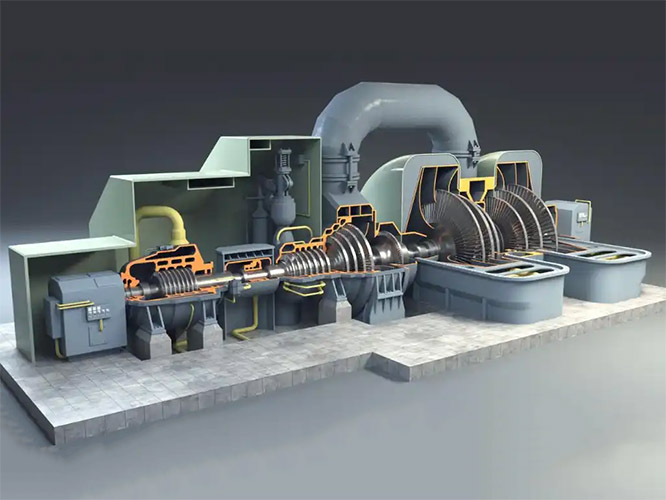
The inherent operating condition constraints of SMR steam turbines are very distinct: the steam pressure and temperature at the reactor outlet are lower than those of conventional thermal power, and the steam moisture content is high, so the share of wet steam losses and water droplet erosion losses increases significantly. Traditional steam turbine design prioritizes maximum efficiency at rated conditions, but SMR plants frequently need to participate in grid peak shaving and operate in part-load ranges over the long term. The new design approach therefore no longer focuses solely on rated-point efficiency, but instead performs full-condition flow path optimization. Through three-dimensional aerodynamic redesign of blade profiles and adjustment of stage enthalpy drop distribution, secondary flow and wake losses at low load are reduced. At the same time, moisture removal structures and built-in drainage channels are incorporated to promptly extract condensed water droplets from the flow path, thereby suppressing erosion damage while reducing the energy losses caused by wet steam, achieving relatively high thermal efficiency across a wide load range.
Thermal system coupling and matching is a key link in reducing costs and improving efficiency. The SMR core output power range is limited, so the regenerative system, condensing system, and bypass system of the turbine island must precisely match the reactor thermal power. Too many regenerative stages will raise equipment investment and increase system complexity; too few stages will cause a decline in cycle thermal efficiency. During the design phase, multi-scheme thermal simulation trade-off studies are conducted to select the optimal regenerative configuration, balancing initial investment and cycle efficiency. Meanwhile, bypass and exhaust schemes are optimized to accommodate the reactor's characteristic of not permitting frequent large disturbances, avoiding the direct discharge of large amounts of steam into the condenser during peak shaving that would cause heat waste, and converting as much of the reactor's thermal output as possible into electrical energy.
Modular integrated design simultaneously compresses manufacturing, transportation, and installation costs. Unlike million-kilowatt-class nuclear steam turbines, which arrive as large individual components and are assembled on site, SMR steam turbines pursue factory pre-assembly and modular delivery. Cylinders, rotors, diaphragms, gland seals, and part of the oil system are integrated into several transportable modules, with flow path clearance verification and assembly commissioning completed in the workshop. After delivery to the project site, only module interconnection is required, greatly shortening the installation schedule and reducing the risk of on-site assembly errors. Modularization also facilitates standardized batch production, diluting mold and process development costs. As demonstration projects are deployed in batches, the unit equipment cost has room for continued decline.
Economic optimization cannot focus only on energy consumption and capital cost; it must also cover full-lifecycle operation and maintenance costs. Wet steam protection, long-life materials, and online condition monitoring form a closed loop with the LCOE objective here. High-efficiency erosion-resistant blades and a stable rotor life management system can extend overhaul intervals and reduce costly rotor and blade replacements. Online monitoring systems for vibration, clearance, and humidity enable predictive maintenance and reduce unplanned outages. For plants with relatively small capacity such as SMRs, the loss from a single outage accounts for a higher proportion of revenue, so reducing outage frequency can improve LCOE even more than a modest increase in flow path efficiency.
However, there is always a trade-off between energy efficiency and cost. Higher-grade high-temperature and corrosion-resistant materials, more complex three-dimensional flow path structures, and more comprehensive monitoring systems all raise initial investment. Engineering teams need to establish an LCOE calculation model to quantify the benefits and inputs brought by each technical upgrade, and to reject over-design. For example, under certain operating conditions, moderately relaxing rated efficiency targets and selecting mature, mass-producible materials may instead yield a better full-lifecycle cost per kilowatt-hour.
On the eve of SMR commercialization, the turbine island is no longer a simple accessory to the reactor. Aerodynamic flow path optimization, thermal system matching, modular manufacturing, and full-lifecycle life management work in synergy, transforming the steam turbine from an "energy conversion device" into a core lever for SMR cost reduction. This design solution, which balances energy efficiency and economics, will help small modular reactors gain a cost advantage in competition with thermal power, large-scale nuclear power, and new energy sources.