


Harbin Electric Turbine's first high-parameter dual-intermediate cylinder extraction unit starts successfully, boosting CHP upgrades.
2026-01-23 15:02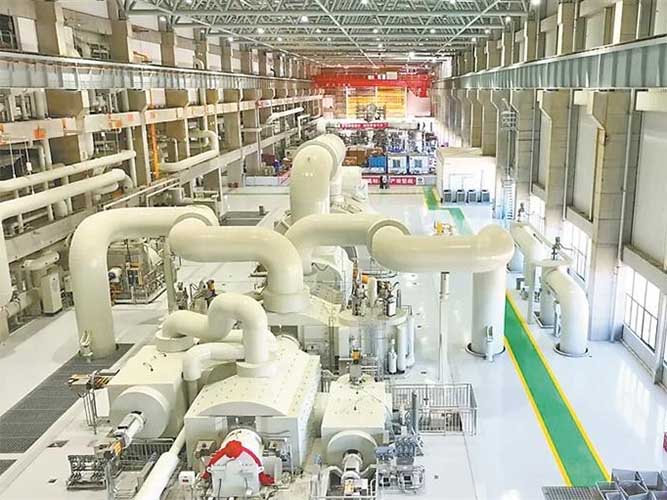
Harbin Electric Turbine Achieves Successful Startup of China's First Independently Developed High-Parameter, Large-Capacity, Adjustable Dual Intermediate-Pressure Cylinder High-Parameter Extraction Unit
The first domestically developed "high-parameter, large-capacity, adjustable" dual intermediate-pressure cylinder high-parameter extraction unit, independently designed and manufactured by Harbin Electric Turbine, achieved a successful one-time startup in the second-phase ultra-supercritical combined heat and power (CHP) project of Guoneng (Fuzhou) Company. All systems of the unit are operating stably, with key performance indicators meeting design standards. This marks a technological breakthrough for China in the field of high-parameter, large-capacity CHP equipment, providing core equipment support for regional energy structure optimization and the achievement of the "dual-carbon" goals.
The newly operational Unit 3 is a 660 MW class core equipment custom-built by Harbin Electric Turbine for this project. It employs an ultra-supercritical, single-reheat, single-shaft four-cylinder double-flow exhaust design, integrating ten-stage regenerative heating and extraction/condensing functions. Equipped with 1220 mm class final-stage moving blades, it balances power generation efficiency with heating adaptability, enabling precise matching of diverse energy demands from industrial production and residential heating.
To overcome the dual challenges of operational efficiency and stability in high-parameter units, the Harbin Electric Turbine team conducted targeted optimization in three core design areas. Refinements to the flow path structure significantly reduced steam energy losses. The adoption of new intermediate-pressure valves and optimization of the steam admission structure enhanced parameter control precision. The innovative integration of overload make-up steam and ultra-high-pressure extraction interchange technologies filled a domestic technical gap for high-pressure-difference operating conditions. Furthermore, the unit is equipped with a reheated extraction control valve featuring noise-reduction orifices and a high-efficiency wide-load-range low-pressure module, allowing adaptation to varying operational demands and achieving high efficiency across the entire load spectrum.
According to the project's technical lead, leveraging synergistic extraction and back-pressure technology, this unit enables cascaded utilization of steam energy. Its thermal efficiency is 3%-5% higher than traditional models, and with no condenser cold source loss, it can reduce fossil fuel consumption by over 10,000 tons annually, corresponding to a reduction of approximately 26,000 tons of CO₂ emissions, demonstrating significant environmental benefits. The extraction pressure deviation can be controlled within ±0.05 MPa, and the steam flow regulation range in the low-pressure section covers 30%-100% of the rated flow, allowing flexible adaptation to regional heat load fluctuations. This ensures stability in both power and heat supply, supporting efficient full-load operation.
The second-phase project of Guoneng (Fuzhou) Company plans to build two identical high-parameter extraction units. Once fully operational, the project's annual power generation is expected to exceed 7.9 billion kWh, with heating capacity covering over a million nearby residents and dozens of industrial enterprises. This will fundamentally resolve the regional gap between industrial steam demand and residential heating supply. Moreover, the units' high efficiency and low-carbon characteristics can promote the replacement of decentralized energy supply with CHP, aiding the local transition towards a cleaner and more intensive energy structure.
In recent years, as the CHP industry has been upgrading towards higher parameters, larger capacities, and lower carbon emissions, the demand for extraction steam turbines as core equipment has been continuously rising. Harbin Electric Turbine has deepened its technological R&D in this field, establishing a comprehensive product matrix of high-parameter extraction units covering from small/medium to large capacities and from low to high parameters. The successful commissioning of this first-of-its-kind unit further solidifies China's technological authority in this domain.
Industry experts indicate that the technological breakthrough and large-scale application of high-parameter extraction units provide a new pathway for the high-quality development of the CHP industry. In the future, as more innovative technologies are implemented, steam turbine equipment will play an even more vital role in areas such as regional energy security and energy conservation/emission reduction, injecting sustained momentum into the realization of China's "dual-carbon" goals.