



Comparison of Scheme Selection between ORC and Steam Turbine for Waste Heat Power Generation
2026-11-12 00:00In industrial production processes, a large amount of waste heat exists in the forms of flue gas, hot water, and low-pressure saturated steam. Whether it can be efficiently recovered and converted into electricity directly affects the plant's energy consumption level and investment returns. Currently, the most widely applied engineering solutions are steam turbine power generation systems and ORC (Organic Rankine Cycle) systems. The two differ in working principles and are suited to very different operating conditions. There is no absolute superiority of one over the other; the core principle is to select the right technology based on the waste heat resource conditions.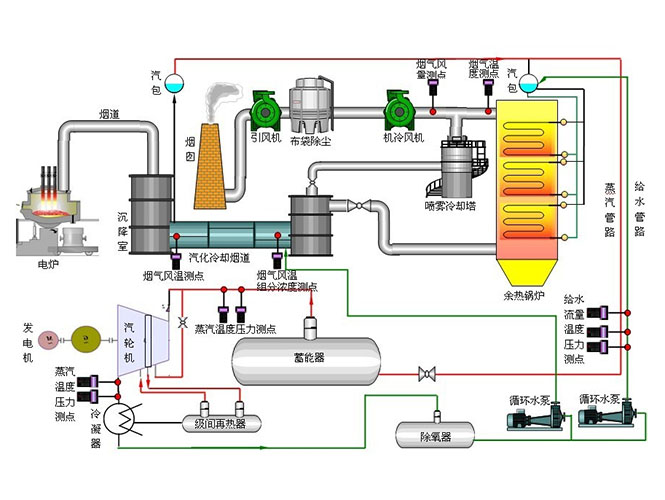
Steam turbines use water vapor as the working fluid, with mature technology and a wide coverage of unit capacities. They are more suitable for medium- and high-temperature waste heat conditions: where the waste heat temperature is relatively high and the steam quality is stable—generally steam above 1.0 MPa or high-temperature flue gas above 300°C—they can produce qualified steam to drive the turbine for power generation. The advantages of steam turbines include high cycle efficiency, lower investment per unit of power generation at large capacities, long equipment life, and a mature spare parts supply chain, making them ideal for chemical and steel waste heat projects that require continuous, stable, year-round full-load operation. Their drawbacks are that under low-temperature conditions, the water-steam cycle efficiency drops significantly; they have high requirements for steam dryness and cleanliness; and the system requires auxiliary equipment such as boilers, deaerators, condensers, and regenerative heaters, resulting in a larger overall footprint and higher demands on the professional competence of operation and maintenance personnel.
ORC systems use organic working fluids with a low boiling point and do not need to heat water into steam. They are suitable for low-temperature waste heat scenarios, typically 80–200°C hot water and low-temperature flue gas. Low-temperature heat sources are difficult to produce steam with adequate parameters, making the steam turbine solution economically unattractive, whereas ORC working fluids can vaporize and expand to perform work at lower temperatures. The characteristics of ORC include compact equipment, a high degree of modularization, simple start-stop operation, better tolerance to heat source fluctuations, a high level of automation, and low routine maintenance workload. It is suitable for scenarios with relatively low heat source temperatures, unstable heat sources, and small unit power output. However, ORC also has notable limitations: high unit cost at large capacities, the risk of organic working fluid leakage, increased long-term costs from working fluid procurement and periodic replacement, and the tendency of organic working fluids to decompose at high temperatures, making them unsuitable for high-temperature waste heat.
In terms of load characteristics, if the heat source is continuously stable with high annual operating hours, the steam turbine should be prioritized; if the heat source is highly intermittent, fluctuates significantly, and the waste heat temperature is low, ORC should be prioritized. In terms of investment threshold, for small-capacity, low-temperature projects, ORC requires less upfront civil works and auxiliary systems; for large-capacity, stable steam waste heat, the steam turbine has a more favorable full-lifecycle cost per kilowatt-hour.
In actual engineering scheme design, hybrid solutions also exist: a portion of high-temperature waste heat goes to the steam turbine, while low-temperature residual heat is then fed into an ORC for cascade utilization, further improving the overall waste heat recovery rate. However, cascade schemes increase system complexity, and it is necessary to assess whether the benefits can cover the added equipment investment.
The core logic of technology selection is not to blindly pursue new technology, but to first fully understand the waste heat's temperature, medium, flow stability, and available annual operating hours, then conduct thermal calculations based on site conditions, operation and maintenance capabilities, and budget, to match the most suitable route. For waste heat power generation service providers, only by accurately distinguishing the applicable boundaries of the two technologies can they provide owners with solutions that deliver real returns and controllable risks.