


Steam Turbine: The Core Equipment of Industrial Power, Enabling Efficient Energy Utilization Across Multiple Fields
2026-05-21 00:00A steam turbine is a thermal engine that converts thermal energy into mechanical energy. Its core working principle involves generating high-temperature, high-pressure steam through fuel combustion. This steam expands and performs work within the turbine, driving the rotor to rotate at high speed, which in turn powers generators or other mechanical equipment. While this principle may seem straightforward, it embodies core technologies in the field of industrial power, making the steam turbine one of the most efficient and widely used pieces of equipment in large-scale power systems today. In the power generation sector, steam turbines, paired with boilers and generators, form the three core components of thermal power plants. In the industrial sector, they are extensively used in scenarios such as waste heat recovery and power drives in steel mills and chemical plants, enabling efficient cyclical utilization of energy.
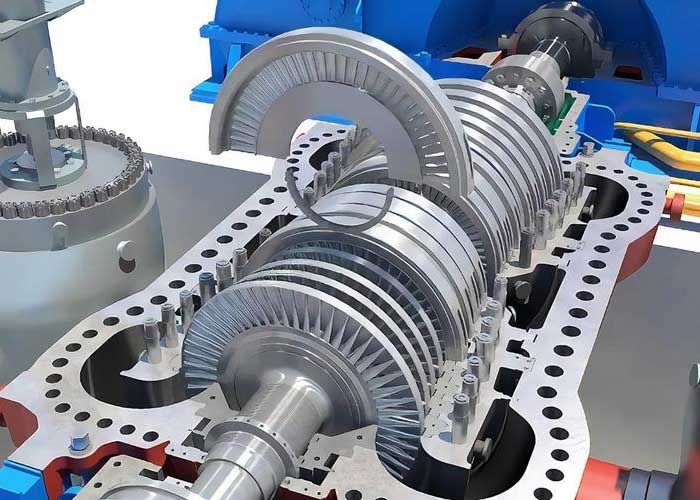
A complete steam turbine system consists of several key components working in synergy, each indispensable. The turbine body is the core part, comprising the rotor, blades, gland seals, and other elements: the rotor is the central rotating component, the blades are the critical medium for steam to perform work, and the gland seals are responsible for sealing the internal space to prevent steam leakage, ensuring efficient energy transfer. The steam generation system acts as the "energy source" for the turbine, producing high-temperature, high-pressure steam through equipment such as boilers, superheaters, and reheaters, providing the power foundation. The speed control system functions like a "steering wheel," regulating the rotational speed via devices like governors, oil pumps, and oil motors to ensure stable operation. The condenser system handles the "recycling" function, condensing the exhaust steam from the turbine into water, enabling water resource recycling and reducing energy consumption.
From a workflow perspective, the operation of a steam turbine involves interconnected steps, forming a complete closed loop of energy conversion. First, fuel is burned in the boiler to produce high-temperature, high-pressure steam. This steam then enters the turbine, expands, and performs work, driving the rotor to rotate. The rotor transmits mechanical energy to a generator or other equipment via a coupling, completing the energy output. Finally, the exhaust steam enters the condenser, where it is condensed into water by cooling water and returned to the steam generation system for reuse. Throughout this process, the stability of each step directly affects the operational efficiency of the turbine, highlighting the importance of system design and manufacturing precision.
Long-term stable operation relies on scientific maintenance and upkeep. As a large-scale precision device, regular inspections, lubrication, cleaning, and preventive maintenance are crucial for ensuring the longevity and performance of a steam turbine. Regular inspections of component conditions help identify and address potential faults promptly. Periodic lubrication reduces component wear and ensures smooth operation. Routine cleaning removes accumulated dust and impurities, preventing impacts on operational precision. Additionally, preventive maintenance based on operational conditions helps identify potential issues early, extending the equipment's service life. These fundamental maintenance tasks are essential for ensuring the long-term, efficient operation of steam turbines.
Depending on classification criteria, steam turbines can be categorized into various types to suit different application scenarios. By working pressure, they include low-pressure, medium-pressure, high-pressure, ultra-high-pressure, subcritical, and supercritical pressure turbines, with higher pressure grades generally corresponding to higher energy conversion efficiency. By thermodynamic cycle, they encompass Rankine cycle, reheat cycle, and cogeneration cycle turbines, each suited to different energy utilization needs. By structural configuration, they include single-cylinder, double-cylinder, and multi-cylinder turbines, with structural differences primarily reflected in power output and application scenarios. This diverse classification system allows steam turbines to flexibly adapt to the power needs of various scales and industries.
With the advancement of the "dual-carbon" strategy and the transformation of the energy structure, the steam turbine industry is accelerating its development toward higher efficiency, sustainability, and intelligence. On one hand, the application of supercritical and ultra-supercritical technologies continuously improves the thermal efficiency of steam turbines, reducing energy consumption and carbon emissions. On the other hand, the integration of intelligent monitoring and operation technologies enables real-time status monitoring, fault prediction, and remote control, significantly enhancing equipment reliability and operational efficiency. Meanwhile, the expansion into emerging scenarios such as industrial waste heat recovery and distributed energy systems presents new development opportunities for small and medium-sized steam turbines, driving the industry toward diversification and customization.
As an "evergreen" in the field of industrial power, the steam turbine has evolved over a century, consistently driven by technological innovation. From its fundamental principles to complex structures, and from daily maintenance to future trends, the steam turbine is not only a core piece of energy conversion equipment but also a vital witness to the development of industrial civilization. In the future, with continuous technological iterations and expanding application scenarios, steam turbines will continue to play a key role in power generation, industry, and new energy sectors, injecting a steady stream of power into efficient energy utilization and the high-quality development of industries.